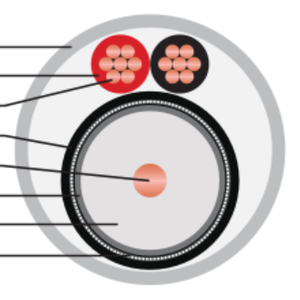
CCTV cables are specialized cables used to transmit video signals from security cameras (CCTV — Closed-Circuit Television) to recording devices like DVRs (Digital Video Recorders) or monitors. Depending on the system, these cables may also carry power and audio signals alongside video. The dense tin coated copper screen ensures complete elimination of EMI/RFI from video signals and also provides reduced DC resistance ground path. The multi stranded construction of video core offers better flexibility and reduced bending radius
CCTV cables have number of uses, depending upon the surveillance requirements. Some of the common applications are as under;
Residential Use: Home security cameras for monitoring entrances, backyards, and indoor areas. Doorbell cameras and baby monitoring systems.
Commercial Buildings: Office surveillance for asset protection, employee monitoring, and access control. Parking lot surveillance systems.
Industrial and Warehouse Surveillance: Monitoring production areas, loading docks, and storage facilities. Integration with alarm systems for safety and theft prevention.
Retail Stores: Monitoring customer activity, cash counters, and entrances/exits. Reducing shoplifting and improving customer safety.
Public Infrastructure: Traffic surveillance and city security cameras. Monitoring in transportation hubs like airports, train stations, and bus terminals.
Specialized Applications: Stadiums, event venues, and concert arenas. Banks and ATMs, schools and university campuses, hospitals and medical facilities.
Worldwide offers coaxial type bundled with two copper conductors power cable (known as Siamese cable: RG59 + Power) CCTV Cable which is the most common for analog CCTV systems. The coaxial cable transmits video signals over long distances with minimal interference, while a power cable (known as Siamese cable: RG59 + Power) carries power to the camera. Modern CCTV systems increasingly use network cables (Cat5e/Cat6) with PoE technology — this allows a
single cable to carry both power and video/data,
making installation cleaner and easier.
Key Features:
Worldwide CCTV cables exhibit qualities that ensure reliable signal transmission, durability, and adaptability for various installation environments. Some key characteristics are as under:
High Signal Integrity
Low Signal Loss: High-quality materials (e.g., oxygen-free copper conductors) minimize attenuation.
Shielding Effectiveness: Braided and/or foil shields protect against electromagnetic interference (EMI) and radio-frequency interference (RFI), ensuring stable video quality.
Consistent Impedance: Have 75 ohms impedance for CCTV applications that helps maintaining signal quality over long distances.
Robust Insulation and Jacketing: Made of durable materials like PVC, LSZH, or UV-resistant compounds to ensure that cable withstands environmental stress.
Temperature Resistance: Carry ability to perform reliably in extreme temperatures, especially for outdoor installations.
Ease of Installation
Compatibility
Environmental Resistance
Cost-Efficiency
Choose worldwide CCTV Cables for clear, noise free and uninterrupted surveillance.
Copyright 2026 © All Right Reserved